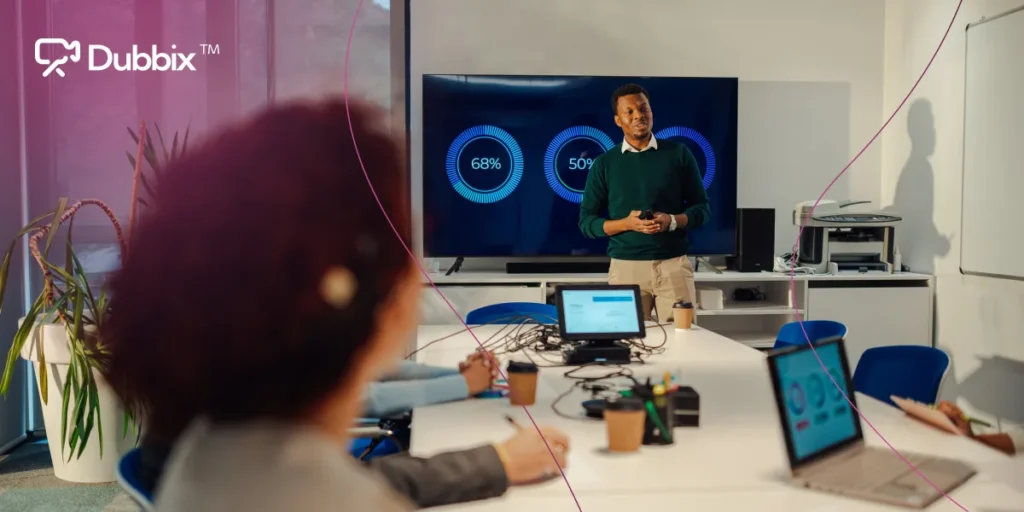



Hybrid meetings bring together people who are physically present in a meeting room and others who join from different locations. When those participants also speak different languages, organizations face another challenge: making sure language does not determine who can participate, contribute, or follow the discussion.
Hybrid meetings and language inclusion means designing meetings so that both remote and in-room participants can access the same conversation, regardless of where they are or which language they speak. Instead of treating language access as an additional feature, organizations can build multilingual communication into the hybrid meeting experience from the start.
With the right combination of Real-time Voice Translation, Universal Captions, Multilingual Chat, and VoiceBridge, hybrid meetings can become more accessible for globally distributed teams, clients, partners, and stakeholders.
What Is Hybrid Meetings and Language Inclusion?
Hybrid meeting language inclusion is the practice of ensuring that participants in both physical meeting rooms and remote locations can understand and participate in a meeting across language differences. Traditional hybrid meeting setups often focus on the technical connection between the room and remote attendees. Cameras, microphones, screens, and conferencing platforms make it possible for everyone to see and hear one another. However, these tools do not necessarily address language barriers.
For a multilingual organization, inclusion requires another layer. A participant sitting in the room may speak one language while a remote participant follows the meeting in another. Without language support, some participants may have to rely on a colleague for interpretation, miss parts of the discussion, or avoid contributing altogether. A language-inclusive hybrid meeting provides participants with access to the conversation in a way that works for their location, preferred language, and communication needs.
Why Hybrid Meetings Create a Language Inclusion Challenge
A hybrid meeting has two different participation environments. In-room participants communicate through the physical room, while remote attendees interact through their devices. This creates potential gaps in multilingual communication. A translation solution designed only for remote participants may leave people sitting in the meeting room without access to the same language support. Similarly, an interpretation arrangement designed only for the physical room may not work for people joining through a browser.
The result can be two separate communication experiences within the same meeting. For example, imagine a multinational company holding a strategy meeting in Lahore with executives joining remotely from Dubai, London, and Madrid. Participants may need English, Urdu, Arabic, or Spanish language support.
If translation is available only through a physical interpreter in the room, remote participants may not receive the same experience. If translation is available only through a remote platform, people physically present may still face a language barrier. The goal should therefore be to create one connected communication environment rather than separate systems for remote and in-room attendees.
Designing an Inclusive Hybrid Meeting Environment
Language inclusion starts before the meeting begins. Organizers should identify who will participate, which languages may be required, and how participants will access translation or captions.
The meeting room should have clear audio pickup so that remote participants can hear speakers without excessive background noise. Cameras should provide remote attendees with a clear view of the person speaking when visual context matters. At the same time, remote participants should have an easy way to access captions, translation, or other language-support features from their own devices.
This approach makes language access part of the meeting design rather than something added when a participant asks for help. Browser-based multilingual meeting platform, Qordenate can support this model by bringing language tools directly into the meeting environment. Participants can access language support without requiring separate interpretation arrangements for every location.
Hybrid Meeting Translation Setup: Connecting the Room and the Screen
A practical hybrid meeting translation setup needs to account for both physical and virtual participation. For in-room participants, translated communication can be delivered through their connected devices, allowing individuals to access the language they understand without requiring the entire room to switch languages. Remote participants can similarly access their preferred language through the meeting interface.
This is particularly useful when several languages are required simultaneously. Instead of translating the entire conversation into one common language, participants can access language channels that match their individual needs.
Qordenate supports live multilingual communication with multiple simultaneous language channels, allowing participants to follow conversations in their preferred language while remaining part of the same meeting. This model also helps avoid a common problem with multilingual meetings: forcing every participant to depend on one interpretation stream. Different attendees may need different languages, and their needs can coexist within the same meeting.
In-Room and Remote Translation: One Meeting, Different Access Points
In-room and remote translation should not mean creating two completely separate translation systems. Consider a company conducting a quarterly meeting from its headquarters. Twenty employees are sitting in the conference room, while another 30 employees are joining remotely from different countries.
Some people in the room may understand English but prefer Arabic. A remote employee may need Spanish. Another participant may need French captions. Rather than interrupting the meeting every time someone needs clarification, language support can be delivered individually.
Qordenate’s multilingual capabilities can help create this shared environment. Remote participants can use features such as Live-Translate and Universal Captions, while multilingual communication can also extend through features such as Multilingual Chat. This allows participants to remain connected to the same discussion while accessing language support through the interface that fits their participation environment.
Making Participation More Equal
Language inclusion is not only about understanding what is being said. It is also about being able to respond. A participant might understand a presentation but hesitate to speak because they are not confident in communicating in the meeting’s primary language. This can be particularly important during client meetings, training sessions, workshops, and international team discussions where participation is expected.
Tools that support multilingual communication can reduce this friction. For example, Qordenate’s VoiceBridge allows participants to type their input and have it delivered as spoken audio in listeners’ preferred languages. This creates another pathway for participation, particularly when someone is more comfortable writing than speaking in the meeting’s primary language.
Multilingual chat can provide another communication layer, allowing participants to ask questions or contribute without interrupting the speaker. Together, these capabilities can make hybrid meetings more accessible to people who would otherwise participate less actively because of language differences.
Hybrid Meetings Should Be Designed Around Participants
The most effective hybrid meeting setup starts with participant needs rather than technology. Meeting organizers should consider which languages participants use, whether attendees are joining remotely or from a physical location, how they will access translated content, and how they can contribute to the conversation.
Instead of asking participants to adapt themselves to a single communication format, organizations can provide multiple ways to engage. Someone can listen to the original speaker, follow translated captions, communicate through multilingual chat, or use spoken translation support when contributing. This flexibility becomes particularly valuable for multinational businesses, international training programs, cross-border client meetings, conferences, and organizations with multilingual workforces.
Building More Inclusive Hybrid Meetings
Hybrid meetings are no longer simply about connecting a conference room to people on laptops. For global organizations, they are increasingly about creating a shared experience for participants who may differ in location, language, and communication preferences.
Hybrid meeting language inclusion requires organizations to think about translation, captions, participation, and accessibility together. When language support is designed into the meeting from the beginning, both remote and in-room participants can have a more consistent way to understand the discussion and contribute to it.
Qordenate provides the multilingual communication layer organizations can use to bring these experiences together, helping teams make language access part of the hybrid meeting rather than an afterthought. Make your next hybrid meeting more inclusive with Qordenate.
Frequently Asked Questions
What is hybrid meeting language inclusion?
How does translation work in a hybrid meeting?
What should a hybrid meeting translation setup include?
What is the difference between in-room and remote translation?
Can remote and in-room participants use different languages?
How can captions support language inclusion in hybrid meetings?
How does Qordenate support multilingual hybrid meetings?