

Video meetings have made collaboration easier across locations, organizations, and borders. But being able to join a meeting does not necessarily mean being able to participate equally. For people with speech differences, hearing difficulties, or communication needs that make live speaking challenging, traditional video meetings can create barriers that have little to do with their knowledge or ideas.
An AI communication platform can help remove those barriers by giving participants alternative ways to contribute. Qordenate’s VoiceBridge is built around this principle. It allows participants to type their contributions during a live meeting and instantly converts those messages into spoken audio in each listener’s preferred language.
The result is a more inclusive meeting experience where how someone communicates does not determine how much their contribution is heard.
Accessibility in Video Meetings Is About Participation
Accessibility is often discussed in terms of whether someone can access a meeting. But true inclusion goes further. A participant may successfully join a video call, understand the discussion, and still struggle to contribute because the meeting depends heavily on spoken communication. Someone with a speech difference may need more time to communicate. A participant with hearing difficulties may find live conversations challenging to follow. Others may communicate more effectively through writing.
These challenges can affect how much someone contributes, even when they have valuable knowledge to share. The problem, therefore, is not necessarily the participant. It can be the communication infrastructure surrounding them.
VoiceBridge is designed to address this barrier by giving participants an alternative way to contribute to live conversations. Built into Qordenate, VoiceBridge allows participants to type their contributions and have them converted into spoken audio, helping make meetings more inclusive without requiring a separate communication workaround.
What Is VoiceBridge?
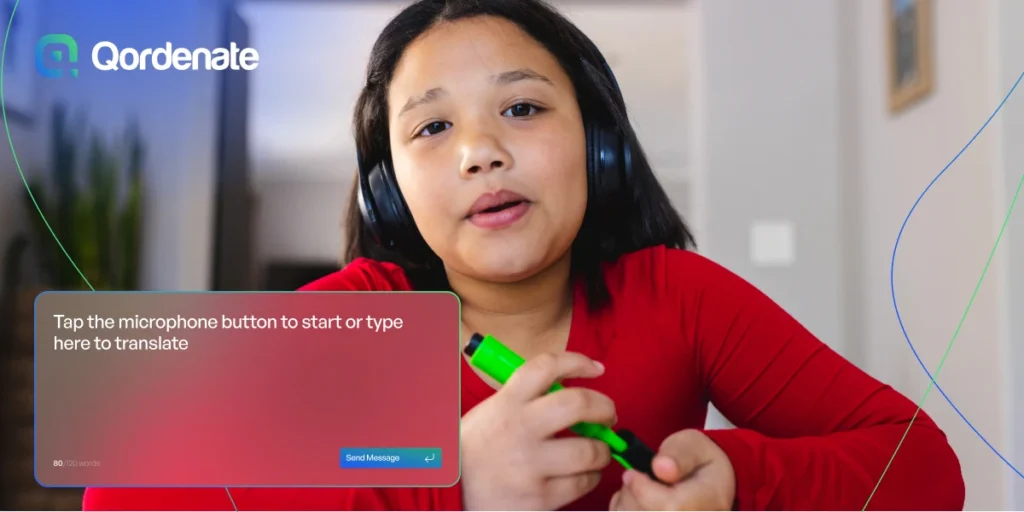
VoiceBridge is a built-in Qordenate feature that allows participants to type their contributions during a live video meeting instead of speaking them aloud.
The platform converts the typed message into spoken audio in real time. That audio is then delivered to listeners in their preferred languages, supporting multilingual communication across 33+ languages.
In practical terms, the process is simple:
- A participant types what they want to say.
- VoiceBridge converts the text into spoken audio.
- The contribution is delivered to meeting participants in their preferred languages across 33+ supported languages.
- The participant’s contribution becomes part of the live conversation.
This creates an alternative communication path without requiring participants to leave the meeting or rely on someone else to communicate for them.
Why VoiceBridge Matters for Inclusive Communication
Traditional meetings often give spoken contributions an advantage. People who can speak quickly and comfortably may naturally participate more, while people who communicate differently may contribute less.
That difference can have real consequences. A participant might have the expertise needed to answer a question but hesitate because speaking is difficult. Another may have an important idea but communicate more effectively in writing. Someone else may understand the discussion but find the pace of spoken conversation difficult to navigate.
VoiceBridge changes the communication mechanism without changing the value of the contribution. Instead of asking participants to adapt themselves to a meeting format built around speech, the meeting can adapt to different communication needs.
This is the foundation of inclusive communication: the medium should not determine whose ideas receive attention.
VoiceBridge Supports People With Different Communication Needs
VoiceBridge is designed for participants with speech differences, hearing difficulties, or communication profiles that make speaking in a live meeting environment difficult. It can also benefit people who communicate more effectively in writing or who find speaking under pressure challenging.
For example, consider a team meeting where an employee has strong ideas but a speech difference makes verbal participation slower. In a conventional meeting, the employee may contribute less simply because the conversation moves quickly.
With VoiceBridge, that employee can type their response and have it delivered as spoken audio to the rest of the meeting. Their communication method changes. The importance of their contribution does not.
This distinction is critical when organizations think about accessibility. The goal should not simply be to provide a separate tool for people with different needs. The goal should be to make participation feel like an ordinary part of the meeting.
An AI Communication Platform Can Remove Communication Barriers
An AI communication platform can play an important role in making virtual meetings more inclusive because AI can transform information between different communication formats in real time.
VoiceBridge demonstrates this through a straightforward interaction: typed input becomes spoken communication. This matters because accessibility is not always about creating a completely different experience for a participant. Sometimes, it is about removing the barrier between the participant and the existing conversation.
Instead of typing a message and sending it separately through chat, the participant can use VoiceBridge to turn their contribution into part of the spoken discussion. That helps reduce the distinction between participants who speak naturally and participants who need another method to communicate.
From Type to Speak: How VoiceBridge Works
VoiceBridge follows a simple three-step process that turns written input into live participation:
1. Type
The participant types the contribution they want to share during the meeting.
2. Convert
VoiceBridge converts the typed message into spoken audio in real time and supports delivery across 33+ languages, helping listeners receive the contribution in their preferred language.
3. Participate
The spoken contribution becomes part of the live meeting conversation, allowing the participant to contribute without needing to communicate verbally.
Inclusive Communication Should Not Make Someone Stand Out
One of the most important aspects of accessible communication is avoiding unnecessary separation. If an accessibility feature makes someone’s participation visibly different from everyone else’s, it can unintentionally reinforce the idea that the person is an exception.
VoiceBridge takes a different approach. Because it is built directly into Qordenate, typed contributions are converted into audio and delivered as part of the same live conversation. There is no need to frame the participant’s contribution as an accessibility workaround.
The objective is simple: every voice should be treated equally, regardless of how that voice enters the conversation. This is particularly important in professional environments where meetings influence decision-making, collaboration, interviews, presentations, and team relationships.
Accessibility and Language Inclusion Can Work Together
Communication barriers do not always exist independently. A participant may have a speech difference while also communicating in a language other than the language most commonly used by the rest of the meeting. In that situation, requiring the participant to speak quickly and in a second language can create an additional barrier.
VoiceBridge addresses both dimensions within the meeting experience. A participant can type their contribution, VoiceBridge converts it into spoken audio, and the audio is delivered to listeners in their preferred languages.
This means the participant does not have to overcome multiple communication barriers before their idea can be heard. For global teams, this can support a more inclusive environment where language and communication differences do not automatically translate into reduced participation.
VoiceBridge as an AI Meeting Assistant
An AI meeting assistant is often associated with tasks such as meeting notes, summaries, or scheduling. But AI can also support the fundamental experience of participating in a meeting.
VoiceBridge demonstrates this broader role. Rather than simply recording or summarizing what people say, it helps a participant take part in the conversation itself.
That makes VoiceBridge particularly relevant to organizations thinking about AI meeting technology from an accessibility perspective. The value of AI is not only in automating tasks around a meeting. It can also help remove barriers within the meeting. For organizations building inclusive virtual workplaces, this distinction matters.
Building Meetings Where Everyone Has an Equal Voice
Inclusive communication starts with recognizing that people do not all communicate in the same way. Some participants speak quickly. Others need more time. Some communicate more effectively through writing. Others may face speech or hearing difficulties that make traditional meeting formats challenging.
A genuinely accessible meeting platform should account for those differences without reducing the participant’s role in the conversation. VoiceBridge provides one way to do that.
By allowing participants to type their contributions and have them converted into spoken audio in real time, it creates another route into live conversation. And because it is built into Qordenate, participants can use that capability as part of the meeting rather than as a separate workaround. The broader goal is not simply accessibility technology. It is equal participation.
When people can communicate in a way that works for them, organizations gain access to ideas that might otherwise remain unheard.
The Future of Accessible Video Meetings
As organizations become more distributed and meetings become increasingly central to collaboration, accessibility needs to become part of the infrastructure of communication.
An inclusive video meeting should not ask participants to prove why they need an alternative way to communicate. It should provide flexible communication options as a normal part of the meeting experience. That is the thinking behind VoiceBridge.
By turning typed contributions into spoken dialogue and delivering them in each listener’s preferred language, VoiceBridge helps remove communication barriers while keeping participants within the same conversation.
The future of accessible meetings is not about giving certain participants a separate seat at the table. It is about making sure everyone has an equal seat in the first place.
Book a demo with Qordenate today and see how VoiceBridge can create more inclusive meetings for your teams.
Frequently Asked Questions
What is VoiceBridge?
Who is VoiceBridge designed for?
How does VoiceBridge support accessibility?
Does VoiceBridge support multilingual communication?
How can organizations use VoiceBridge to support inclusive meetings?