A multilingual meeting is not limited to what participants say aloud. Questions appear in the chat. Links are shared. Participants add clarifications, reactions, and follow-up information. For global teams, these written exchanges can be just as important as the spoken conversation. That creates a problem: what happens when the meeting is translated, but the chat isn’t?
Participants may understand the speaker while missing an important question from a colleague, a shared resource, or a clarification posted in another language. Research on virtual meetings shows that parallel chat can improve inclusion by allowing people to contribute without interrupting the main conversation.
Research on multinational teams also shows that language barriers can reduce participation and interfere with knowledge processing. For organizations working across languages, multilingual communication therefore needs to extend beyond speech. The meeting chat needs translation too.
Why Does Meeting Chat Need Translation?
Meeting chat needs translation because it carries questions, links, clarifications, and follow-up information that spoken translation alone does not cover. Multilingual Chat lets participants write in their own language and read messages in theirs, helping everyone follow the written conversation alongside the spoken one.
What Is Multilingual Chat?
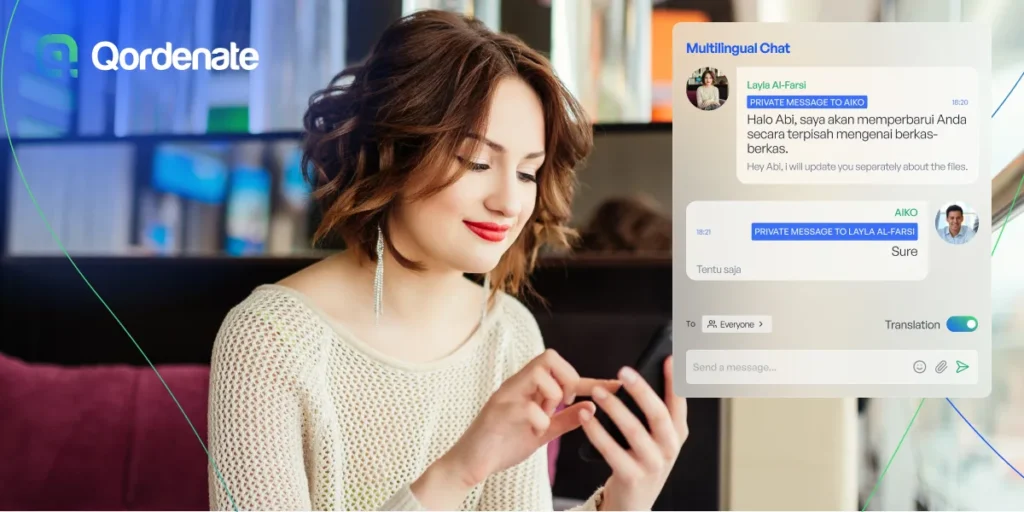
Multilingual Chat is a meeting feature that translates written messages so participants using different languages can communicate within the same meeting. Rather than copying messages into a separate translation tool, participants can type in their language while other attendees read the translated message in theirs.
It complements translated speech and captions by covering the written side of a meeting. For example, Qordenate’s Multilingual Chat feature translates in-meeting messages into recipients’ preferred languages, helping make questions, shared links, and follow-up notes more accessible.
Meeting Chat Is Part of the Conversation
Meeting chat is easy to treat as a secondary feature. In practice, it can become an important parallel communication channel. Research found that participants use meeting chat for questions, links to resources, additional information, responses, agreement, and other forms of interaction. The research also found that chat can allow people to participate without competing for the speaking floor.
Consider a global product meeting. While the presenter is explaining a new feature, one participant posts a link to the latest product documentation. Another asks a question. A third adds a clarification about a regional requirement. None of these contributions necessarily interrupt the presenter, but they still contribute to the meeting.
This makes chat particularly valuable for people who may not always feel comfortable speaking. Someone who needs more time to formulate a response, someone who doesn’t want to interrupt, or someone who hasn’t had an opportunity to speak can use chat to participate. In this sense, chat can make meetings more inclusive. But there is a catch: participation is only inclusive when people can understand what others are saying.
Chat can also become a record people revisit after the meeting. Participants may return to a shared link, review a clarification, or look back at a question while completing a task. If those messages remain in a language they cannot comfortably read, the information gap can continue after the live conversation ends.
Language Barriers Can Silence Valuable Contributions
Global teams bring together people with different languages, cultures, and communication styles. A common working language may make collaboration possible, but it doesn’t necessarily eliminate every language barrier. Research found that evident language barriers can reduce participation in multinational team communication. The same research also identified hidden language barriers that can impair shared sensemaking, ultimately affecting knowledge processing.
That matters in meetings because participation is connected to knowledge sharing. Imagine a team meeting involving employees from Germany, Brazil, Japan, and the United States. The official meeting language is English, but not everyone is equally comfortable communicating in it. A participant may hesitate to interrupt the discussion to ask a question or explain an idea.
Chat can lower that barrier by providing another way to contribute. But if that participant writes in their strongest language and other attendees cannot understand it, the benefit disappears. This is why language inclusion should not be limited to making the spoken conversation understandable. The written conversation needs to be accessible too.
For example, imagine a regional team in the Gulf Cooperation Council (GCC) with Arabic, English, and Hindi-speaking colleagues. During a project meeting, an Arabic-speaking colleague posts a question in Arabic, an English-speaking manager shares a link, and a Hindi-speaking team member adds a clarification in Hindi. Without translated chat, participants may need to ask for explanations or switch to another tool. With Multilingual Chat, each participant can follow written contributions in their preferred language.
What Happens When Meeting Chat Isn’t Translated?
Imagine that a sales team is conducting a product demonstration for prospects from several countries. The presenter speaks English, and translated captions help everyone follow the presentation. During the demo, however, a prospect posts a question in Spanish.
Another participant responds in Spanish. Someone else shares a Spanish-language comment about a specific product requirement. The spoken portion of the meeting is accessible, but the written conversation is not. This creates a communication gap.
Meeting chat can contain:
- Questions that deserve an immediate response
- Links to documents, websites, or resources
- Clarifications about something being discussed
- Additional information that adds context
- Responses and follow-up discussions
Research specifically identifies these as common uses of parallel meeting chat. It also notes that chat can continue to support discussion and coordination after the meeting ends. Without translation, participants may have access to only part of that information.
That means translated speech + untranslated chat = incomplete multilingual communication.
How Multilingual Chat Works
- A participant writes a message in their preferred language.
- Qordenate translates the message for other participants according to their language settings.
- Recipients read the translated message within the in meeting chat.
- Participants can respond and continue the written conversation across languages.
In Qordenate, participants can access Multilingual Chat from the meeting controls and enable its translation toggle. Messages can then be translated into each recipient’s preferred language.
Translation Should Improve Access, Not Add More Complexity
There is another challenge: meeting chat already creates an additional stream of information. Participants may be listening to the speaker, watching a presentation, reading captions, and monitoring chat simultaneously. Research on parallel chat has identified distraction, information overload, and information asymmetries as potential problems.
So multilingual chat translation should not simply add more text to an already busy screen. The goal should be to make written communication easier to understand while keeping the experience manageable.
A useful multilingual chat experience should help participants:
- Understand messages in their preferred language
- Follow questions and responses without constantly switching tools
- Access shared information without relying on another participant to translate it
- Participate without creating unnecessary cognitive load
This is particularly important for accessibility. Microsoft Research’s guidance on meeting chat emphasizes considering participants with different accessibility needs and being intentional about how chat is presented and used. The objective is not to translate everything indiscriminately. It is to ensure that language does not become an unnecessary barrier to information and participation.
Why Multilingual Chat Matters for Global Meetings
For organizations working across borders, multilingual chat can support several types of meetings.
Global team meetings
Employees can ask questions and contribute ideas without being restricted by a single working language.
International sales meetings
Prospects can share questions or requirements in the language they are most comfortable using, while other participants can understand and respond.
Training and webinars
Attendees can use chat to ask questions, share reactions, or request clarification without interrupting the presenter in webinars.
Customer and partner meetings
Organizations can communicate with international customers and partners while reducing the need to move between separate translation tools. Across all of these situations, the principle is the same: language inclusion should cover the whole communication experience, not just the speaker’s voice.
What to Look for in a Multilingual Chat Solution
If your organization is considering multilingual meeting technology, look beyond whether a platform simply offers translation. Consider four questions:
Does it support the languages your participants actually use?
Language requirements vary across teams, customers, and regions. A useful solution needs to support real-world multilingual communication.
Does it fit naturally into the meeting experience?
Translation should reduce friction rather than create another layer of complexity.
Make the Entire Meeting Multilingual With Qordenate
Qordenate is designed for multilingual meetings where communication extends beyond spoken conversation. Its Multilingual Chat feature helps participants communicate across languages within the meeting experience, alongside Qordenate’s broader multilingual communication capabilities.
Instead of treating chat as separate from the meeting, organizations can make written communication part of a more language-inclusive experience. Because when a meeting brings people together across languages, every message matters, not just the ones spoken aloud. Make your meetings more inclusive with multilingual communication. Explore Qordenate and see how your teams can collaborate across languages.
Frequently Asked Questions
What is multilingual chat?
Why does meeting chat need translation?
How does multilingual chat support inclusion?
Does translation support participation as well as comprehension?
Can participants understand chat without leaving the meeting?