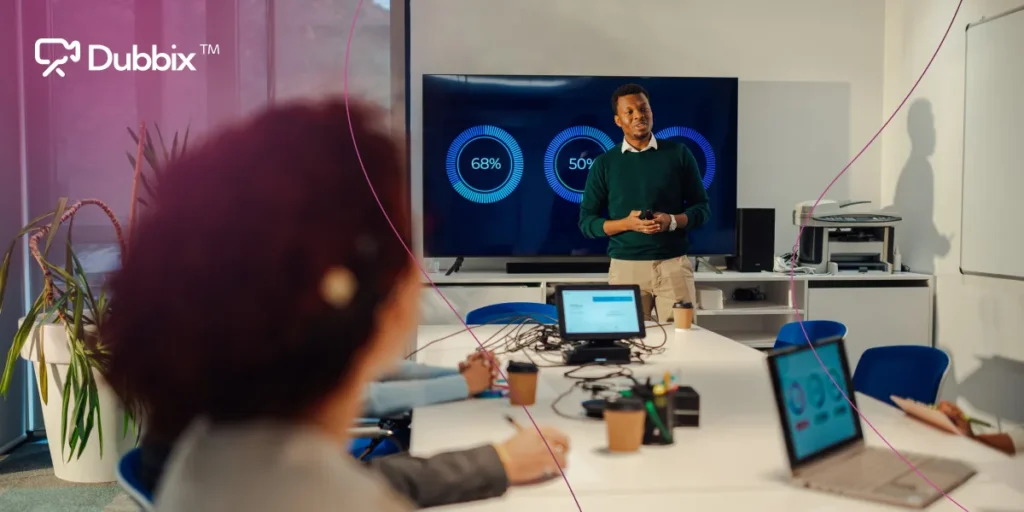
A multilingual sales demo helps sales teams present products and services in the language their prospects are most comfortable speaking and understanding. Instead of relying entirely on English or asking buyers to navigate a language barrier, businesses can make sales presentations more accessible through real-time translation, multilingual captions, and localized communication.
For global sales teams, this matters because a successful demo is not simply about showing what a product can do. It is about making sure the prospect understands the problem, the solution, the value, and the next steps.
What Is a Multilingual Sales Demo?
A multilingual sales demo is a product presentation or sales meeting where participants can communicate and understand the discussion across different languages. For example, a sales representative based in the United States might conduct a product demonstration for prospects in France, Saudi Arabia, Brazil, or Japan. Rather than requiring every participant to communicate exclusively in English, multilingual communication technology can help participants follow the presentation in their preferred languages.
A multilingual sales demo can include:
Why Language Matters During a Sales Demo
A sales demo is often where a prospect decides whether a product is worth further consideration. If the buyer struggles to understand the presentation, important information can be lost. Technical terminology, pricing details, product workflows, integrations, and business benefits can become difficult to follow when the conversation is happening in a language the prospect does not fully understand. This can create several problems.
1. Product Value Can Get Lost
A salesperson may clearly explain how a product solves a specific business problem. But if the prospect misses key details because of language limitations, the perceived value of the solution can be lower than its actual value.
2. Questions Become More Difficult
Prospects need to ask questions during a demo. Language barriers can make buyers hesitant to interrupt, clarify a point, or explain their specific requirements. That can result in a less interactive sales conversation.
3. Technical Information Can Become Confusing
B2B sales demos frequently involve complex concepts such as APIs, integrations, workflows, security, analytics, or implementation requirements. When this information is communicated in an unfamiliar language, even a knowledgeable buyer may need additional clarification.
4. The Buyer Experience Suffers
Sales is partly about building trust. Giving prospects the ability to communicate in a language they understand can make the experience more comfortable and inclusive.
How Real-Time Translation Can Support a Global Sales Demo
Traditional sales teams often handle international demos by hiring interpreters, preparing translated materials, or conducting separate presentations for different markets. These approaches can work, but they can also add time and operational complexity. Real-time translation provides another approach. With multilingual meeting technology, a salesperson can conduct one live presentation while participants access translated communication in their preferred languages.
For example:
Sales representative: English
Prospect 1: French
Prospect 2: Arabic
Prospect 3: Spanish
Instead of requiring everyone to communicate in English, participants can use multilingual communication tools to follow the conversation more comfortably. This can be especially useful for international sales teams conducting:
- Product demonstrations
- Enterprise sales presentations
- Discovery calls
- Product launches
- Partner meetings
- Customer onboarding sessions
- Procurement discussions
- Technical demonstrations
Multilingual Sales Demos vs. Traditional Sales Presentations
A conventional sales demo usually assumes that everyone participating can comfortably communicate in the presentation language. That assumption becomes less practical as businesses expand internationally.
| Traditional Sales Demo | Multilingual Sales Demo |
| One primary language | Multiple languages can be supported |
| May require separate presentations | One presentation can support diverse audiences |
| Prospects may rely on their own language skills | Prospects can follow in their preferred language |
| Questions may be limited by language barriers | Multilingual interaction can encourage participation |
| Translation may happen separately | Translation can be integrated into the meeting experience |
A multilingual approach does not mean that every sales representative needs to speak multiple languages. Instead, technology can help bridge the communication gap.
How to Create an Effective Multilingual Sales Demo
Translation alone does not automatically create a good sales presentation. The demo still needs to be structured around the prospect.
Use Clear, Simple Language
Even when translation technology is available, sales teams should avoid unnecessarily complicated language.
Use:
- Short sentences
- Clear terminology
- Consistent product names
- Familiar business language
- Simple explanations of technical concepts
This makes the original speech easier to understand and can also support clearer translation.
Make Demonstrations Visual
Screens, workflows, dashboards, product interfaces, and diagrams can reinforce what the salesperson is saying. Visual information is particularly useful when several languages are being used during the same meeting.
Leave Space for Questions
Do not make the demo a one-way presentation. Give prospects opportunities to ask questions, clarify information, and discuss their specific requirements. A multilingual sales environment should support interaction, not just translated speech.
Using Multilingual Captions During Sales Presentations
Not every prospect wants translated speech. Some buyers may prefer reading captions in their native language while continuing to hear the original speaker. Multilingual captions can therefore be useful during:
- Product demonstrations
- Webinars
- Sales presentations
- Investor presentations
- Technical discussions
- Online conferences
For example, an English-speaking salesperson can present normally while a Spanish-speaking prospect follows the discussion through Spanish captions. This allows the prospect to understand the presentation without requiring the salesperson to deliver the entire demo in Spanish.
Making Multilingual Sales Meetings More Interactive
The strongest sales conversations are two-way. Prospects should be able to ask questions, share concerns, and communicate with the sales team without constantly worrying about language.
Qordenate supports multilingual communication through features such as Real-time Translation, Universal Captions, Multilingual Chat, and VoiceBridge. This can allow participants to choose communication methods that work best for them.
For example, a prospect who is more comfortable writing than speaking can use multilingual chat. Another participant can follow the conversation through translated captions, while someone else can use translated voice communication. The result is a sales meeting designed around communication rather than a single shared language.
Why Multilingual Sales Demos Matter for Global B2B Sales
For companies selling internationally, language accessibility can become part of the overall sales experience. A prospect evaluating an enterprise solution may already be comparing multiple vendors. If the sales process requires them to overcome unnecessary communication barriers, the experience can become more difficult. A multilingual sales process can help businesses:
- Communicate product value more clearly
- Support international prospects
- Encourage questions and participation
- Reduce misunderstandings
- Create more inclusive sales experiences
- Conduct meetings with geographically distributed teams
- Support expansion into multilingual markets
It can also help sales teams avoid creating completely separate communication processes for every market.
How Qordenate Supports Multilingual Sales Conversations
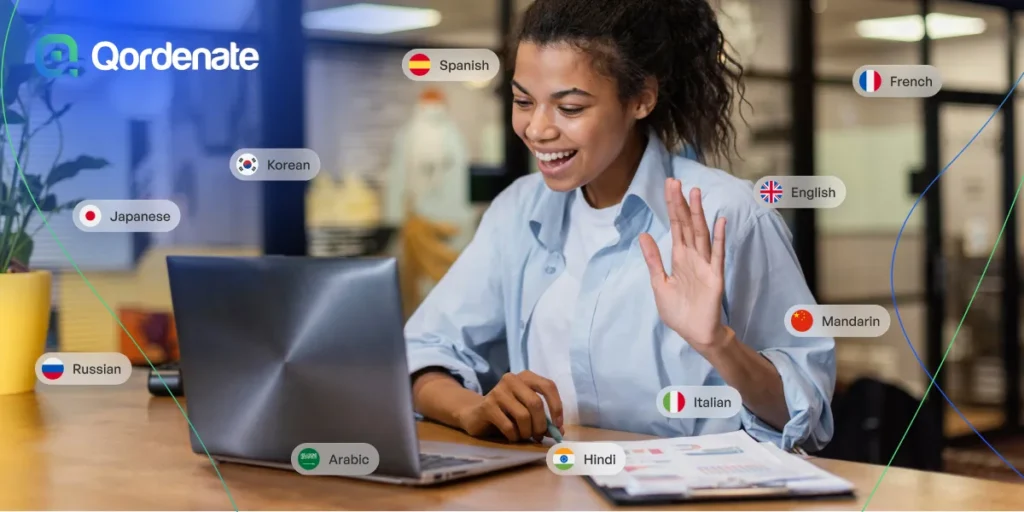
Qordenate is a browser-based multilingual communication platform designed to help people communicate across languages during meetings, webinars, and other online interactions. With support for 33+ languages, Qordenate enables participants to communicate across language barriers without requiring additional plugins. Together, these capabilities can help sales teams create a more accessible experience for international prospects while keeping the sales conversation focused on the buyer.
Turn Language Accessibility Into a Sales Advantage
Global selling does not always require creating a completely different sales process for every country. Sometimes, the first step is simply making the existing conversation easier to understand.
A multilingual sales demo can help sales teams communicate product value, answer questions, and engage prospects across language barriers. Instead of asking prospects to adapt entirely to the seller’s language, businesses can create a sales experience that adapts to the people in the room.
For teams conducting international demos, webinars, and sales meetings, Qordenate provides the communication layer needed to make multilingual conversations more accessible. Ready to make your next sales conversation more inclusive? Explore Qordenate and see how multilingual communication can support your global sales meetings.
Frequently Asked Questions
What is a multilingual sales demo?
How can multilingual sales demos help sales teams?
Can a sales demo be conducted in multiple languages at the same time?
What is the difference between multilingual captions and real-time translation?
How many languages does Qordenate support?