


Language barriers can make even the most productive global meeting difficult to follow. A live voice translator app can help participants communicate across languages by translating spoken conversations as they happen. But Real-time Voice Translation is only one way to make a multilingual meeting easier to understand.
Qordenate combines Real-Time Voice Translation with Universal Captions, giving participants two ways to follow a conversation: they can hear the translated speech or read the translated text in their preferred language. The difference between these features matters because listening and reading serve different communication needs. Understanding how each works can help organizations create more accessible, inclusive, and effective multilingual meetings.
What Is Real-Time Voice Translation?
Real-Time Voice Translation uses AI to translate spoken language during an ongoing conversation. Instead of waiting for a recording to be translated afterward, participants receive translated speech while the meeting is happening.
Qordenate’s Real-Time Voice Translation allows participants to speak naturally in their own language while other participants hear the translated version in their preferred language. The platform detects speech, processes the language, translates it, and delivers the translated audio in real time.
For example, an English-speaking participant can speak normally while a Spanish-speaking participant hears the translated conversation in Spanish. A third participant can select another supported language.
Qordenate supports 33+ languages, up to six live languages within a meeting, and meetings with up to 300 participants. This makes a live voice translator app particularly useful when the goal is to keep conversations moving naturally without requiring participants to speak one common language.
What Are Universal Captions?
Universal Captions provide live translated text on screen while a meeting is taking place.
Rather than changing what participants hear, captions change what they can read. Qordenate’s Universal Captions display a live transcription of spoken conversation translated into each participant’s preferred language.
For example, if a presenter speaks English:
- One participant can read Spanish captions.
- Another can read Arabic captions.
- Another can read French captions.
- Another can read Japanese captions.
Everyone can follow the same conversation while reading it in their selected language. Universal Captions can be particularly useful in noisy environments, for participants who prefer reading, or when visual reinforcement helps someone process information more effectively.
Universal Captions vs Real-Time Voice Translation: What’s the Difference?
The simplest distinction is:
Real-Time Voice Translation translates what participants hear, while Universal Captions translate what participants read.
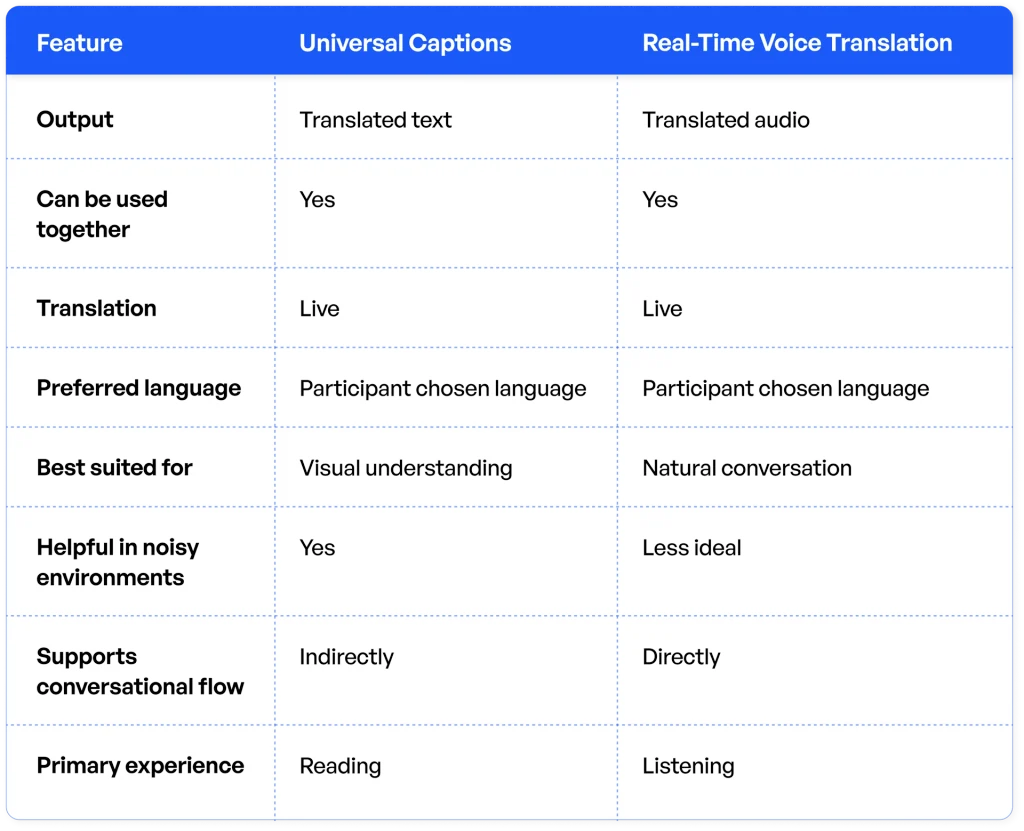
The important point is that these features are not necessarily alternatives. Qordenate specifically provides Universal Captions alongside translated audio, allowing participants to use a second visual channel while listening to translated speech.
How Real-Time Voice Translation Works in a Live Meeting
With Qordenate, the workflow begins when participants select their preferred languages and enable live translation. Participants then speak normally while the system detects their speech and produces translated voice output for other participants.
The process can be simplified into:
Spoken language → Speech recognition → AI translation → Translated voice → Listener
The goal is to keep the translation experience inside the meeting rather than requiring participants to switch between separate translation applications. For global meetings, this can reduce the need for participants to mentally translate what someone is saying before responding. That matters particularly when conversations involve questions, explanations, negotiations, or rapid back-and-forth discussion.
When Should You Use Real-Time Voice Translation?
Real-Time Voice Translation is most useful when conversation is the priority. Imagine a multinational team discussing a new project. One employee speaks English, another speaks Spanish, and another speaks Arabic. If everyone can hear translated speech in their preferred language, participants can focus on the discussion rather than translating every sentence themselves.
Real-Time Voice Translation can be useful for:
- Global team meetings
- International client calls
- Educational sessions
- Cross-border collaboration
- Executive meetings
- International webinars
- Multilingual training
- Customer discussions
- Government meetings
The biggest advantage is conversational flow. Participants can listen, respond, ask questions, and continue the discussion without having to rely exclusively on written translation.
When Are Universal Captions More Useful?
Universal Captions are especially valuable when reading adds clarity to the conversation. Consider a technical presentation. A presenter might mention a product name, technical term, number, or important instruction. Even when a participant hears the translated audio, seeing the words on screen can make the information easier to verify.
Captions can also help when:
- The meeting environment is noisy.
- Participants have difficulty hearing audio clearly.
- Someone prefers reading while listening.
- A discussion includes technical terminology.
- Participants need visual reinforcement.
- Accessibility is an important consideration.
- Attendees want to follow the conversation without relying entirely on audio.
Qordenate’s Universal Captions provide this additional visual channel while the meeting is happening.
Why Use Universal Captions and Voice Translation Together?
The strongest multilingual meeting experience does not always require choosing between audio and text. In many situations, the two features work better together.
Imagine a global product presentation. The presenter speaks English. A participant in Brazil hears translated Portuguese audio while reading Portuguese captions. Another participant in Saudi Arabia hears Arabic translation and reads Arabic captions.
The participants can choose how they process the information. Someone may primarily listen. Someone else may primarily read. Another participant may use both.
This flexibility matters because multilingual communication is not only about translating a sentence correctly. It is also about making sure the translated information is understandable and accessible to the person receiving it.
Real-Time Voice Translation vs Captions for Different Meeting Types
Different meetings can benefit from different communication modes.
Global Team Meetings
Real-Time Voice Translation can help employees communicate naturally during discussions, while Universal Captions provide an additional visual reference.
International Training
Captions can reinforce important instructions, terminology, and learning material while translated audio keeps the session conversational.
Global Webinars
Real-Time Voice Translation allows international attendees to hear the presentation in their preferred languages, while captions give them another way to follow the content.
Qordenate supports multilingual webinars and meetings with up to six simultaneous language channels and up to 300 participants.
Client and Sales Meetings
Voice translation can be particularly useful when sales conversations involve questions, objections, product explanations, and negotiation.
Government and Public Meetings
Both features can improve language access by allowing participants to hear and read translated information during live discussions.
How an AI Meeting Assistant Complements Multilingual Meetings
Translation addresses the language barrier, but meetings also generate another challenge: information overload. This is where an AI meeting assistant can complement multilingual communication.
During a meeting, participants may need to focus on the conversation rather than taking notes. Afterward, they may need to remember decisions, actions, and key discussion points.
Qordenate’s Smart Recap generates an AI-powered meeting summary in the English language after the session, helping participants review important information without manually documenting the entire conversation.
This creates a broader meeting workflow:
Hear: Real-Time Voice Translation
Read: Universal Captions
Chat: Multilingual Chat
Participate: VoiceBridge
Review: Smart Recap
The result is a meeting experience that addresses communication during the session and information retention afterward.
Which Is Better: Universal Captions or Real-Time Voice Translation?
Neither is universally better. The right feature depends on what participants need.
Choose Real-Time Voice Translation when:
- Natural conversation is the priority.
- Participants need to respond quickly.
- Meetings involve active discussion.
- Participants prefer listening to translated speech.
- You want to reduce dependence on a shared meeting language.
Choose Universal Captions when:
- Participants benefit from reading.
- The environment is noisy.
- Visual reinforcement is important.
- Technical terms or numbers need to be followed carefully.
- Participants want translated text alongside spoken communication.
Use both when:
- The meeting is complex.
- Participants have different communication preferences.
- Accessibility is important.
- You want both audio and visual translation.
- The discussion involves important information that participants need to understand accurately.
Why the Difference Matters for Global Organizations
Global organizations increasingly need meetings where language does not determine who can participate effectively. A participant should not have to struggle through a second language simply because it is the default language of the meeting.
Real-Time Voice Translation addresses this by translating spoken communication into the listener’s preferred language. Universal Captions add another layer by allowing participants to read that conversation in their preferred language. Together, these capabilities can make multilingual meetings more flexible and inclusive.
Qordenate is designed around this model, combining Real-time voice translation and Universal Captions within the same meeting environment. It supports 33+ languages, up to six live languages per meeting, and up to 300 participants.
For organizations working across countries, departments, customers, and language groups, that means multilingual communication can become part of the meeting itself rather than a separate translation process.
Make Every Multilingual Meeting Easier to Follow
Universal Captions and Real-Time Voice Translation solve different parts of the same communication problem.
Real-Time Voice Translation helps participants hear the conversation in their preferred language. Universal Captions help them read it. Neither feature has to replace the other. When both are available, participants can choose the communication mode that works best for them while staying in the same meeting.
Qordenate brings these capabilities together with multilingual chat and VoiceBridge to support communication before, during, and after a multilingual meeting.
Ready to make multilingual meetings easier for everyone? Explore Qordenate and see how real-time voice translation and Universal Captions can help your teams communicate across languages.
Frequently Asked Questions
What is a live voice translator app?
What is the difference between Universal Captions and real-time voice translation?
Can Universal Captions and real-time voice translation work together?
How many languages does Qordenate support?
How many participants can join a Qordenate meeting?