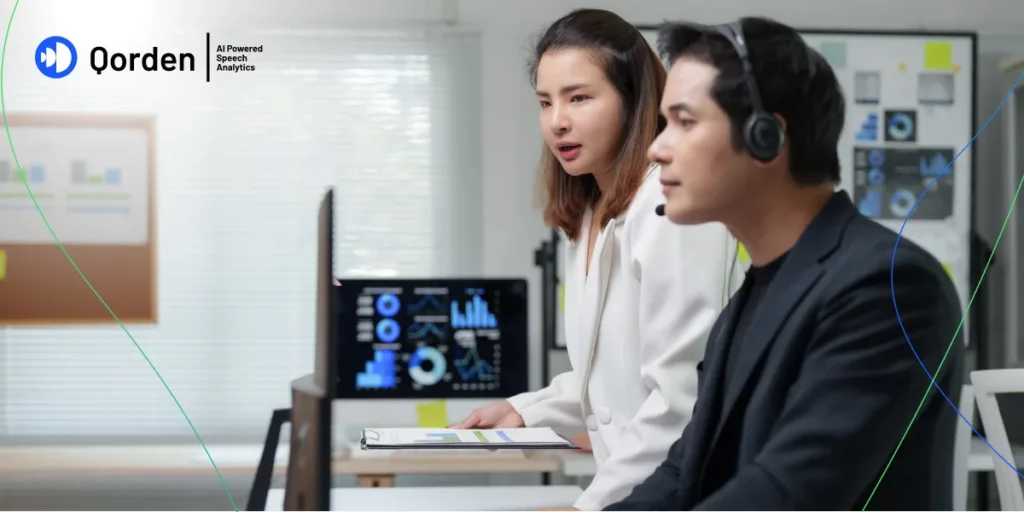



Customer interactions contain more information than the words being spoken. A customer may say that everything is “fine” while sounding frustrated, or politely ask for help while showing signs of dissatisfaction. Sentiment analysis in contact centers helps businesses identify these emotional signals at scale by analyzing conversations and determining whether interactions are positive, negative, or neutral.
For contact centers, this can provide valuable insight into customer experience, agent performance, service quality, and emerging issues. Instead of relying only on manual reviews or customer surveys, organizations can use AI to analyze conversations and identify patterns across a much larger volume of interactions.
What Is Sentiment Analysis in a Contact Center?
Sentiment analysis in a contact center is the use of AI to analyze customer conversations and identify the emotional tone or sentiment expressed during an interaction. Traditional quality assurance often focuses on whether an agent followed a script, used required phrases, or completed specific steps. Sentiment analysis adds another layer by examining how the interaction is progressing emotionally.
For example, an AI system may identify an interaction as:
- Positive: The customer expresses satisfaction, appreciation, or enthusiasm.
- Neutral: The conversation is primarily informational without strong emotional signals.
- Negative: The customer expresses frustration, dissatisfaction, anger, or disappointment.
More advanced systems can analyze sentiment throughout the conversation rather than assigning a single label to the entire call. This allows contact center leaders to identify moments where sentiment deteriorated, improved, or changed after an agent intervention.
What Is Sentiment Call Analysis?
So, what is sentiment call analysis in practical terms? Sentiment call analysis uses AI to examine recorded or transcribed conversations and detect language and conversational patterns associated with customer sentiment. Depending on the technology, analysis can consider factors such as word choice, phrases, conversational context, and changes in tone. Consider a customer calling about a delayed delivery.
At the beginning, the customer might say:
“I just want to know where my order is.”
Later, after receiving an explanation and a resolution, the customer might say:
“Okay, thanks for sorting that out.”
A sentiment analysis system can help identify this shift from potential frustration toward a more positive interaction. This is particularly useful because contact centers handle thousands or millions of conversations. Manually listening to every interaction is difficult, making it challenging for managers to understand customer sentiment across the entire operation.
How Does AI Tone Detection Work in Calls?
AI tone detection in calls focuses on identifying vocal and conversational signals that can provide additional context beyond the literal words being spoken. A customer saying “That’s great” could indicate genuine satisfaction or, depending on the context and delivery, frustration or sarcasm. AI-based conversation analysis can examine patterns in the interaction to provide additional insight into the customer’s emotional state.
AI tone detection may consider signals such as:
- Changes in speaking patterns
- Emotional intensity
- Repeated negative phrases
- Expressions of frustration or dissatisfaction
- Positive acknowledgments
- Escalation-related language
- Changes in sentiment during a conversation
The exact signals analyzed depend on the technology and model being used. Sentiment analysis should therefore be treated as an analytical indicator rather than a definitive measurement of a person’s emotions.
What Does Contact Center Sentiment Analysis Measure?
Sentiment analysis can measure several aspects of customer interactions.
1. Overall Customer Sentiment
The simplest application is determining whether an interaction is predominantly positive, neutral, or negative. This gives managers a high-level view of customer experience across calls, agents, teams, products, or support issues.
2. Sentiment Changes During a Call
A single sentiment label does not always tell the full story. A customer may begin a call frustrated but become satisfied after the agent resolves the problem. Conversely, a conversation that starts positively may become negative if the issue is not resolved. Tracking sentiment changes can help organizations understand where and why conversations change direction.
3. Recurring Sources of Negative Sentiment
When negative sentiment repeatedly appears around a particular topic, it can reveal potential problems.
For example, negative conversations may cluster around:
- Billing issues
- Product defects
- Delivery delays
- Long wait times
- Refund requests
- Account problems
- Complicated policies
This allows contact center and business teams to investigate the underlying cause rather than treating every complaint as an isolated incident.
4. Agent-Customer Interaction Patterns
Sentiment analysis data can also provide context for agent performance. Managers can investigate whether certain interaction patterns consistently lead to improved or declining customer sentiment. This can inform coaching and training programs. Importantly, sentiment should not be used as the sole measure of agent performance. A negative interaction may result from a product, policy, or technical problem that is outside the agent’s control.
Why Does Sentiment Analysis Matter for Contact Centers?
Contact centers generate enormous amounts of conversational data, but much of that information remains difficult to analyze manually. Sentiment analysis can turn conversations into structured insights that organizations can use to identify trends and prioritize reviews.
Improve Customer Experience
Negative sentiment can act as an early indicator that customers are encountering problems. Teams can investigate recurring issues and identify opportunities to improve products, policies, processes, or support experiences.
Prioritize Quality Assurance
Traditional quality assurance often relies on manually selecting a sample of calls for review. AI-powered conversation analytics can help teams identify interactions that require attention based on factors such as negative sentiment, escalation signals, or other quality indicators. This allows managers to spend more time reviewing potentially important conversations instead of selecting calls randomly.
Strengthen Agent Coaching
Instead of relying only on occasional evaluations, managers can use conversation data to identify recurring patterns. For example, if conversations frequently become more negative during a particular stage of an interaction, managers can investigate whether additional training or coaching could help.
Identify Emerging Customer Issues
Sentiment trends can reveal changes in customer experience before they become obvious through traditional reporting. If negative sentiment increases around a product, service, policy, or process, teams can investigate the underlying conversations and determine what is driving the change.
Sentiment Analysis vs. Traditional Customer Feedback
Surveys and customer feedback forms remain useful, but they capture only a portion of the customer experience. Customers may not complete surveys, and responses often reflect the customer’s experience at a specific point in time. Contact center conversations provide another source of customer feedback because they occur naturally as customers seek support, information, or resolution.
Sentiment analysis allows organizations to analyze these conversations systematically rather than relying entirely on post-interaction surveys. The two approaches can complement each other: surveys can capture explicit customer feedback, while conversation analytics can reveal patterns within actual customer interactions.
How Qorden Uses AI to Analyze Contact Center Conversations
Qorden’s conversational intelligence capabilities help organizations move beyond manually sampling conversations and toward broader analysis of customer interactions. By applying AI to conversations, contact center teams can identify patterns in customer sentiment, interaction quality, and recurring issues across large volumes of calls.
This can support a more data-driven approach to quality assurance and customer experience management. Instead of asking only “What did the agent say?” teams can also investigate “How did the conversation progress, and what patterns appear across interactions?” For organizations handling large contact volumes, this creates an opportunity to turn conversational data into actionable business intelligence.
Best Practices for Using Sentiment Analysis
Sentiment analysis works best when it is treated as one component of a broader conversation intelligence strategy.
Use Sentiment as a Signal, Not a Final Judgment
AI sentiment scores should provide context for human review rather than replace human judgment entirely.
Combine Sentiment With Other Conversation Metrics
Sentiment becomes more useful when analyzed alongside factors such as resolution outcomes, escalation patterns, compliance, customer effort, and agent behaviors.
Look for Trends
One negative interaction may not indicate a systemic problem. Repeated patterns across customers, agents, products, or time periods can provide more meaningful insights.
Connect Insights to Action
The purpose of sentiment analysis is not simply to generate dashboards. Organizations should use insights to improve training, customer journeys, processes, products, and service delivery.
Turn Contact Center Conversations Into Actionable Insights
Customer conversations contain valuable signals about experience, service quality, and operational problems. Sentiment analysis in contact centers gives organizations a way to surface those signals at scale and understand how interactions are changing over time. With AI-powered conversation intelligence, contact center teams can move beyond reviewing isolated calls and begin identifying patterns across their broader customer experience.
Explore Qorden’s conversational intelligence capabilities to turn contact center conversations into actionable insights.
Frequently Asked Questions
What is sentiment analysis in a contact center?
What is call sentiment analysis used for?
What is AI tone detection in calls?
Can sentiment analysis identify angry customers?
Why is sentiment analysis important for contact centers?
Does sentiment analysis replace human quality assurance?