


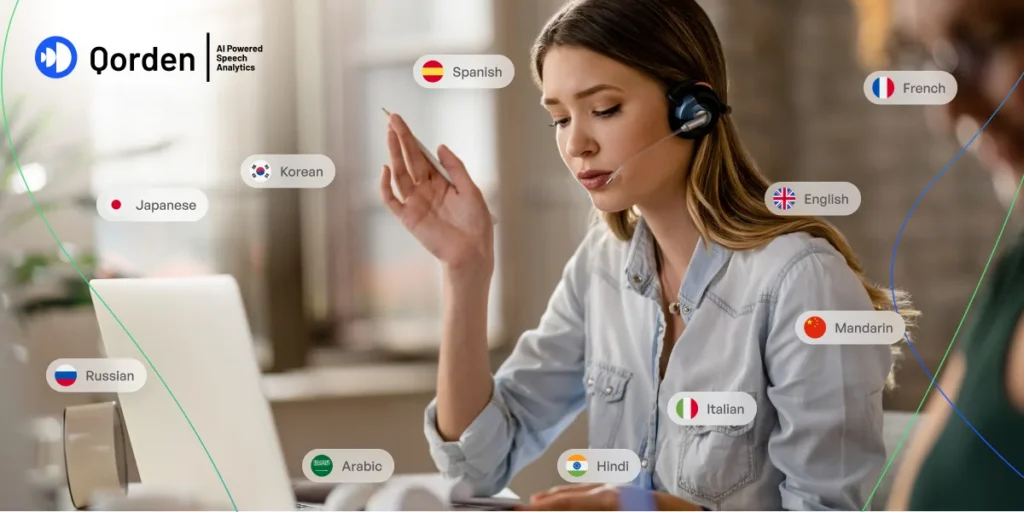
Customers expect fast, accurate, and accessible support, regardless of where they are or what language they speak. Multilingual customer support AI helps businesses break down language barriers by enabling customer service teams to understand, translate, and analyze conversations across languages.
Instead of limiting support to the languages spoken by individual agents, organizations can use AI to create a more consistent experience for customers across global markets. For international businesses and contact centers, multilingual AI is becoming an important part of delivering scalable customer support without compromising communication quality.
What Is Multilingual Customer Support AI?
Multilingual customer support AI is artificial intelligence designed to understand, translate, transcribe, and analyze customer interactions across multiple languages. It can support customer service teams throughout the conversation lifecycle, from understanding what a customer says to analyzing the interaction after it ends.
Depending on the platform, multilingual AI can help businesses:
- Transcribe customer conversations in different languages
- Translate conversations between customers and agents
- Identify customer intent and recurring issues
- Analyze customer sentiment
- Detect important keywords and phrases
- Assist agents during live interactions
- Automate conversation summaries and documentation
- Evaluate conversations for quality and compliance
- Identify trends across multilingual customer interactions
The goal is not simply to translate words. Effective multilingual customer support AI helps organizations preserve the meaning, context, and intent of customer conversations.
Why Multilingual Customer Support Matters
Language can have a direct impact on the customer experience. A customer may understand a company’s product or service but struggle to explain their problem in the language supported by the contact center. At the same time, an agent may understand the issue but lack the language skills needed to communicate effectively.
This can result in:
- Longer resolution times
- Repeated explanations
- More transfers between agents
- Increased customer frustration
- Higher support costs
- Inconsistent service between markets
For businesses operating across multiple countries, these challenges can become difficult to manage at scale. Multilingual AI can help reduce this friction by allowing customer service teams to communicate with customers in more languages while maintaining a consistent support process.
How Multilingual Customer Support AI Works
Multilingual AI can support customer conversations at several stages.
1. AI Understands the Customer
The first step is accurately understanding what the customer is saying. AI-powered speech recognition can convert spoken conversations into text and identify the language being used. This gives customer service teams a searchable and analyzable representation of the interaction. This capability becomes especially valuable when customers use informal language, regional expressions, or switch between languages during a conversation.
2. AI Translates the Conversation
Translation allows agents and customers who speak different languages to communicate more effectively. Rather than requiring organizations to hire separate teams for every language, AI can help bridge the communication gap between customers and available agents. For customer service, context matters. A useful translation system needs to account for the meaning of the conversation rather than treating every sentence as an isolated group of words.
3. AI Assists Agents
Multilingual AI can also help agents during live customer interactions. Depending on the implementation, agents may have access to translated conversation content, real-time transcripts, relevant information, or AI-generated assistance. This allows human agents to focus on solving the customer’s problem instead of spending excessive time trying to overcome language barriers. The result is a collaborative model where AI supports communication while human agents provide empathy, judgment, and problem-solving.
4. AI Analyzes Conversations
The value of multilingual AI extends beyond the individual customer interaction. Once conversations are transcribed and structured, organizations can analyze them to identify common questions, complaints, customer sentiment, service gaps, and emerging trends. This is where multilingual conversation intelligence becomes particularly valuable for large customer service operations.
Speech Analytics for Customer Support: Understanding Every Conversation
Speech analytics for customer support uses AI to analyze customer conversations and extract insights from interactions at scale. Traditional quality assurance often relies on supervisors manually reviewing a limited number of calls. This makes it difficult to understand what is happening across thousands—or millions—of customer conversations.
AI-powered speech analytics can help teams identify:
- Frequently discussed customer issues
- Common product complaints
- Customer sentiment and emotional signals
- Agent performance trends
- Compliance-related phrases
- Escalation triggers
- Repeated customer questions
- Opportunities for agent coaching
- Changes in customer expectations
Multilingual capabilities make these insights even more valuable for global businesses. Imagine a company operating customer support teams in five different countries. If its analytics system only evaluates English conversations, leadership may receive an incomplete picture of customer experience. With multilingual conversation analytics, organizations can analyze interactions across different languages and markets, creating a more comprehensive view of customer needs.
AI in Contact Centers: From Automation to Intelligence
The adoption of AI in contact centers is changing how customer service teams operate. AI is not limited to customer-facing chatbots. It can support agents, automate repetitive processes, analyze conversations, and help managers make better decisions. For multilingual contact centers, these capabilities can be particularly useful.
Agent Assistance
AI can provide agents with transcripts, translations, relevant information, and contextual insights during customer interactions.
Automated Quality Assurance
Instead of manually reviewing a small percentage of calls, AI can evaluate much larger volumes of customer conversations against predefined quality or compliance criteria.
Customer Experience Analytics
AI can identify trends in customer sentiment, complaints, questions, and interaction outcomes.
Automated Documentation
AI can summarize conversations and reduce the amount of manual note-taking required from agents.
Intelligent Escalation
AI can identify conversations that require human attention and provide agents with the relevant context needed to take over effectively. Together, these capabilities can help contact centers become more efficient without removing the human element from customer service.
Benefits of Multilingual Customer Support AI
1. Deliver a More Inclusive Customer Experience
Customers can communicate more naturally when they have access to support in their preferred language. This can make interactions more accessible and reduce the friction caused by language barriers.
2. Improve Resolution Times
Translation and transcription can help agents understand customer issues more quickly. By reducing unnecessary transfers and repeated explanations, businesses can work toward faster resolutions.
3. Scale Support Across Markets
Hiring dedicated support teams for every language can be expensive and operationally complex. Multilingual AI can extend the capabilities of existing teams and help organizations serve additional markets without creating completely separate support operations.
4. Create More Consistent Service
Customer expectations should not change simply because they are speaking a different language. AI-powered workflows can help organizations apply similar quality assurance and customer service standards across different markets.
5. Gain Insights From More Customer Conversations
Businesses can learn more when they can analyze conversations across languages. Instead of treating each market as an isolated operation, organizations can identify patterns across their entire customer base.
How to Choose Multilingual Customer Support AI
The number of supported languages should not be the only factor businesses consider when evaluating a multilingual AI solution.
Language Coverage
Look for support for the languages, dialects, and accents your customers actually use.
Translation and Transcription Quality
Poor transcription or translation can affect everything that comes after it. Accuracy should therefore be a core consideration.
Real-Time Capabilities
If the goal is to support live conversations, determine whether the platform can provide real-time transcription, translation, or agent assistance.
Conversation Analytics
Look for analytics capabilities that help teams understand sentiment, topics, keywords, compliance, and customer experience trends across languages.
Scalability
The solution should be able to handle growing interaction volumes without creating significant operational complexity.
Integration
Multilingual AI should work alongside the systems already used by your contact center, such as CRM, telephony, and customer experience platforms.
Human Handoff
AI should complement human agents rather than creating unnecessary barriers between customers and support teams. Complex, sensitive, or high-value interactions should be easy to escalate.
The Future of Multilingual Customer Support
Customer service is becoming increasingly global. Customers can purchase products from companies thousands of miles away, interact with international brands through digital channels, and expect the same level of support regardless of their location.
That creates a challenge for businesses: How can customer service scale globally without creating a fragmented customer experience?
Multilingual customer support AI provides one answer. By combining language understanding, translation, transcription, conversation analytics, and agent assistance, businesses can reduce language barriers while creating a more scalable support operation. The opportunity goes beyond simply speaking more languages. It is about making every customer conversation understandable, measurable, and actionable.
Serve Every Customer in Their Language
Language should not determine the quality of customer support someone receives. With multilingual customer support AI, businesses can help customers communicate more naturally, empower agents to handle multilingual interactions, and gain valuable insights from conversations across markets. As AI in contact centers continues to evolve, organizations that invest in multilingual capabilities can build customer support operations that are not only more scalable, but also more inclusive.
Ready to make multilingual customer communication easier for your support teams? Book a demo with Qorden today and discover how AI can help your organization deliver more accessible, consistent customer experiences across languages.
Frequently Asked Questions
What is multilingual customer support AI?