


Healthcare depends on clear communication. Patients need to explain symptoms, understand questions, follow instructions, and participate in decisions about their care. However, when patients and healthcare professionals speak different languages, communication can become more difficult, particularly when an interpreter is not immediately available.
Real-time translation for healthcare is AI-powered technology that translates spoken conversations between different languages as they happen, helping patients and healthcare professionals communicate more effectively.
It helps bridge this gap by translating spoken conversations as they happen. For healthcare organisations, it can support multilingual consultations, virtual appointments, patient services, and communication between care teams. For example, Qordenate provides real-time AI translation across 33+ languages, with up to six live languages available in a meeting.
The purpose is not simply to translate individual sentences. Instead, it is to make multilingual conversations easier to follow, allowing participants to communicate in their preferred languages without unnecessarily interrupting the flow of the conversation.
The Interpreter Gap in Healthcare
Language barriers can affect almost every stage of the patient experience.
The scale of the language-access challenge in healthcare is significant. According to the U.S. Agency for Healthcare Research and Quality (AHRQ), approximately 25 million people in the United States, or 8.6% of the population, have limited English proficiency, while around 57 million people speak a language other than English at home. This highlights the need for healthcare organisations to provide accessible multilingual communication throughout the patient journey.
For instance, a patient may have difficulty explaining symptoms. A nurse may need to communicate preparation instructions. Similarly, a specialist may need to speak with a patient or colleague who is more comfortable communicating in another language. Administrative teams may also interact with patients who speak different languages when scheduling appointments or providing information.
Professional interpreters remain important for many healthcare situations, especially when precise interpretation is required. However, an interpreter may not always be immediately available for every interaction.
This creates an interpreter gap: the period between when multilingual communication is needed and when appropriate language assistance becomes available.
As a result, real-time translation technology can help healthcare organisations address some of the communication needs around this gap. Instead of requiring every participant to share a common language, a multilingual meeting platform can allow people to speak naturally while translated audio and captions help others follow the conversation.
How Real-Time Translation Supports Patient Care
Real-time translation uses AI to translate spoken communication while a conversation is taking place. Rather than stopping after every sentence for manual translation, participants can continue speaking while the translated conversation is delivered in their selected language.
In healthcare, this can support situations such as:
- Virtual patient consultations
- Multilingual healthcare meetings
- Patient and family communication
- Healthcare training and education
- Communication between international care teams
- Remote consultations involving multiple languages
- Group healthcare sessions and webinars
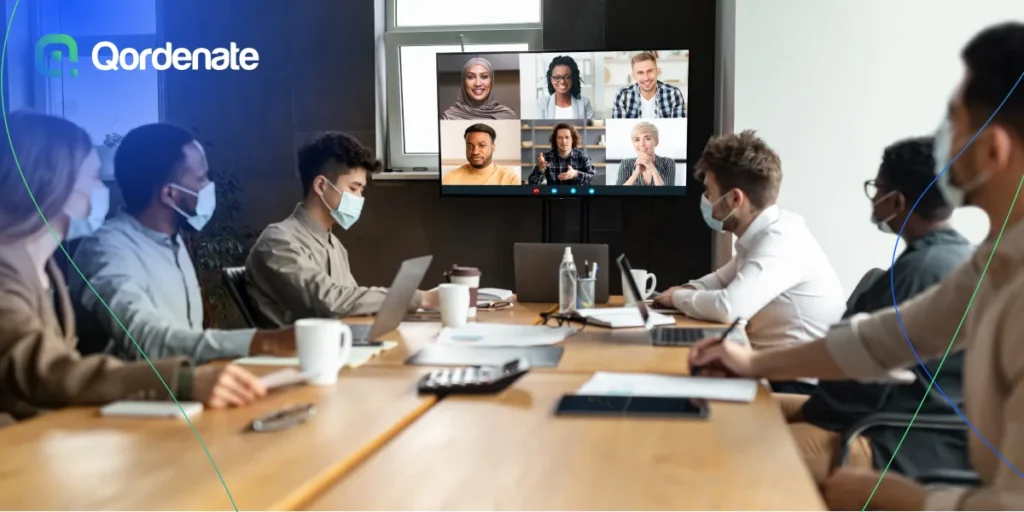
Qordenate is a video meeting platform with real-time translation built into the meeting experience. Participants can speak in their own language while other participants hear the conversation in theirs. The platform supports 33+ languages, up to six live languages per meeting, and meetings with up to 300 participants.
As a result, translation can become part of the conversation rather than a separate process that participants have to manage manually.
Multilingual Customer Support AI for Healthcare Communication
Healthcare communication does not stop when a consultation ends. Patients also communicate with healthcare organisations through reception teams, administrative departments, support services, virtual care platforms, and follow-up interactions.
This is where multilingual customer support AI can help extend accessible communication beyond the clinical conversation.
For example, a patient may contact a healthcare provider to ask about an appointment but may be more comfortable speaking a language that the support representative does not speak. In such cases, a multilingual communication platform can help bridge that language difference, allowing the conversation to continue without requiring both people to share the same language.
For healthcare organisations serving linguistically diverse communities, multilingual communication can contribute to a more consistent patient experience across different touchpoints.
Moreover, the same principle applies internally. Healthcare organisations often bring together doctors, nurses, administrators, specialists, and other professionals from different linguistic backgrounds. Real-time translation can help participants follow discussions and contribute without having to mentally translate everything into a shared language.
How a Live Voice Translator Solution Supports Healthcare Communication
Healthcare communication is not always limited to a scheduled meeting. Staff may need to communicate with patients or colleagues during different stages of care, while remote teams may need to join conversations from different locations.
Therefore, the concept of a live voice translator solution is relevant to healthcare communication. A voice translation tool can help people communicate when they need spoken translation in real time rather than relying only on written translation.
For healthcare organisations, however, the technology should be viewed as an assistive communication layer, not an automatic replacement for professional medical interpretation. This distinction matters because healthcare conversations can involve diagnoses, medication, consent, treatment decisions, and other information where precision is essential.
Beyond Voice Translation: A Multilingual Healthcare Communication Experience
Translation is only one part of effective multilingual communication. In addition, healthcare participants may need to read what is being said, communicate through text, or review important decisions after a meeting.
Qordenate combines several communication features within the same meeting environment. Its Live Voice Translation allows participants to hear spoken communication in their own language in real time. At the same time, Universal Captions provide live translated text, while Multilingual Chat translates written messages for participants in their preferred languages.
Qordenate also includes VoiceBridge, which allows a participant to type their contribution and have it converted into spoken audio in each listener’s language. As a result, this can support participants who have speech difficulties.
For healthcare teams, having these capabilities in one environment can make multilingual meetings more flexible. Depending on the situation, participants can listen, read, or communicate through text based on what works best for them.
Real-Time Translation for Virtual Healthcare
Telehealth translation has expanded access to healthcare by allowing patients and professionals to communicate remotely. However, geographical distance does not eliminate language barriers.
A virtual consultation might involve a patient in one location, a healthcare professional somewhere else, and additional family members or specialists joining remotely. If participants speak different languages, communication can become another barrier to an otherwise accessible consultation.
Qordenate is browser-based, so participants can join meetings without downloading software. It supports Chrome, Edge, and Safari, while each participant can have an individual preferred language setting.
Furthermore, for larger healthcare sessions, Qordenate supports up to 300 participants. Its platform can also provide up to six live languages within a meeting, making it suitable for multilingual group communication as well as smaller conversations.
Security and Multilingual Healthcare Communication
Healthcare organisations also need to consider how communication platforms handle sensitive information. Qordenate uses point-to-point encryption for data in transit and at rest and holds ISO 27001 and ISO 27018 certifications, with on-premises and sovereign cloud deployment options available for regulated environments.
Creating More Accessible Patient Communication
The interpreter gap is ultimately a communication challenge. Patients need to be heard, healthcare professionals need to understand what patients are saying, and multilingual teams need to collaborate effectively. Ultimately, real-time voice translation can help reduce one part of that challenge.
Qordenate brings Real-Time Translation, Universal Captions, Multilingual Chat and VoiceBridge into one multilingual meeting environment. Its language engine supports 33+ languages, while meetings can accommodate up to 300 participants and up to six live languages.
For healthcare organisations, this creates an opportunity to make multilingual communication more accessible without adding another disconnected translation workflow to every meeting. The interpreter gap will not disappear through technology alone. Nevertheless, when used appropriately alongside professional interpretation and existing healthcare communication practices, real-time translation can help ensure that language is less often an unnecessary barrier between patients, providers, and care teams. Book a demo and Explore Qordenate to see how your healthcare organisation can create more inclusive communication across languages.
Frequently Asked Questions
What is real-time translation in healthcare?
Can real-time translation replace a healthcare interpreter?
How many languages does Qordenate support?
Can Qordenate support large healthcare meetings?
Can patients join a Qordenate meeting without downloading software?
How can real-time translation help healthcare organisations?