


Government and public services depend on clear communication. Residents need to understand policies, access essential services, ask questions, and participate in public discussions. However, language differences can make these interactions difficult.
Real-time voice translation uses AI to translate spoken conversations as they happen. As a result, government employees, public-service teams, and residents can communicate across language barriers. With Qordenate, organizations can support multilingual meetings with 33+ languages, up to six live languages per meeting, and meetings of up to 300 participants.
Why Language Access Matters in Government and Public Services
Government agencies serve diverse communities, often across multiple languages. From municipal offices and public consultations to immigration services and community programs, communication is central to effective public service.
For example, a resident may need help understanding a government process but struggle to explain their situation in the agency’s primary language. Similarly, a public-service employee may have important information to share with a community that speaks another language.
Public meetings can create similar challenges. A city council or public consultation may include residents from several linguistic backgrounds. Without effective language access, some participants may find it harder to follow the discussion or share their views.
When communication breaks down, residents may misunderstand instructions or miss important information. In some cases, they may even avoid engaging with public services.
Traditionally, government organizations have relied on interpreters, translated documents, multilingual staff, or separate translation applications. These approaches remain useful. However, they can become difficult to scale when agencies need to communicate with residents across many languages and locations.
Real-time voice translation provides another layer of language access. Instead of requiring everyone to speak the same language, AI translates spoken conversations while they are happening.
Therefore, multilingual communication can become part of everyday service delivery rather than an occasional accommodation.
How Real-Time Voice Translation Works for Public Services
Real-time voice translation uses AI to process spoken language. First, the system recognizes the speaker’s words. It then translates the speech into the selected language. Finally, the translated output is delivered to the listener.
Spoken conversation → AI speech recognition → Language translation → Translated voice → Listener receives translated audio
This workflow can support both one-to-one interactions and larger meetings. For example, government teams can conduct multilingual virtual sessions. Public agencies can communicate with international residents. Officials can also collaborate with colleagues across regions.
Qordenate is built around a language engine rather than adding translation as a separate layer to a traditional meeting platform. It supports 33+ languages and up to six live languages within a meeting. In addition, participants can select their preferred language independently.
As a result, participants spend less effort translating conversations in their heads. Instead, they can focus on the information, questions, and decisions being discussed.
Multilingual Customer Support AI for Government Services
Government agencies increasingly operate as service organizations. Residents contact departments for information, applications, appointments, documentation, permits, benefits, immigration processes, and other public services.
Therefore, multilingual customer support AI can play an important role in government communication.
For example, a resident may need to discuss an application with a public-service representative. The resident may feel more comfortable speaking Spanish, Arabic, Mandarin, or another supported language. Instead of requiring the resident to communicate in a second language, AI-assisted translation can help both sides understand the conversation more naturally.
This approach can support:
- Resident inquiries
- Public-service appointments
- Immigration and settlement assistance
- Community outreach
- Municipal services
- Government information sessions
- Public consultations
- Cross-border services
- Multilingual help desks
The goal is not simply to translate words. Instead, the aim is to reduce communication barriers. Residents can ask questions, explain their needs, and understand responses more effectively.
As a result, government teams can provide a more accessible service experience across different language groups.
AI Communication Platform for Government Teams
Government communication does not happen only between employees and residents. Agencies also conduct internal meetings, cross-department briefings, public consultations, training sessions, webinars, and stakeholder discussions.
An AI communication platform can bring these interactions into one multilingual environment. Instead of moving between separate tools for video conferencing, translation, captioning, chat, and note-taking, teams can manage key communication needs within one workflow.
Qordenate combines real-time voice translation with features designed for multilingual meetings, including Universal Captions, Multilingual Chat, VoiceBridge, and Smart Recap, which provides summaries in English.
This creates a more connected communication workflow:
Before the meeting: Government teams can invite residents, officials, community representatives, and external stakeholders to join through a browser. Participants do not need to download additional software.
During the meeting: Officials and residents can speak in their preferred languages. Meanwhile, AI provides real-time translated voice and universal captions. This helps participants follow public consultations, government briefings, and community discussions.
Written communication: Multilingual Chat allows participants to ask questions and share information in their preferred languages. Therefore, written communication can remain accessible during public-service meetings.
After the meeting: Smart Recap provides an AI-generated summary in English. It captures key information, decisions, and action items. Government teams can then review discussions and follow up on resident or stakeholder needs.
Together, these capabilities support public consultations, resident services, community outreach, interdepartmental meetings, and multilingual government briefings.
Explore Qordenate to see how AI-powered multilingual communication can support your government team.
Public Meetings and Community Consultations
Public meetings are one of the most visible areas where language access matters.
A city council meeting, community consultation, or public information session may include residents who speak several different languages. If interpretation is available for only some languages, other residents may receive less information. They may also participate less actively.
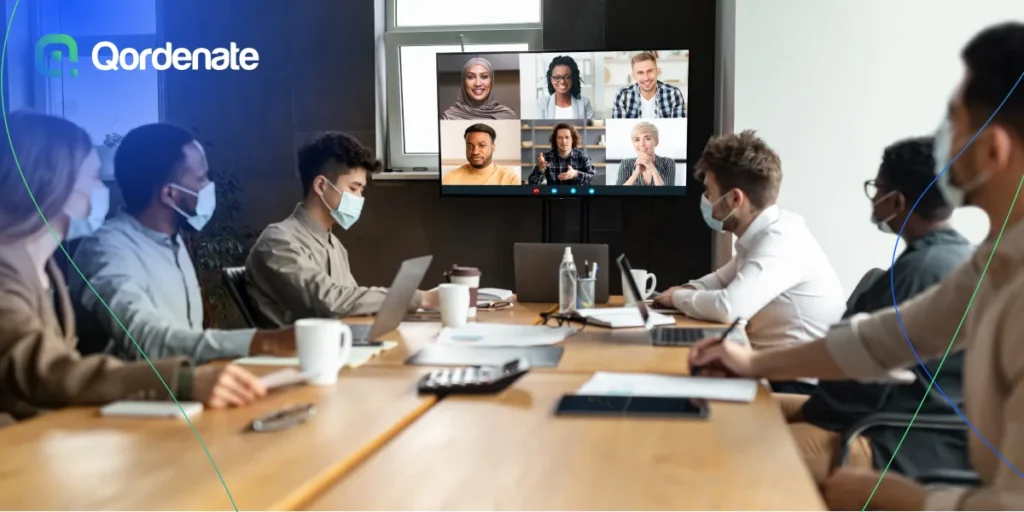
Qordenate’s Government and Public Services use case addresses this challenge. Participants can hear meetings in their preferred languages in real time. The platform supports up to six live languages in a meeting and up to 300 participants.
This can be useful for:
- City council meetings
- Immigration and citizenship hearings
- Town halls
- Public consultations
- Community briefings
- Policy information sessions
- Government webinars
- Stakeholder meetings
- Public education campaigns
When residents can follow a discussion in a language they understand, participation becomes less dependent on their ability to follow the dominant language.
Therefore, real-time translation can help create more inclusive public discussions.
Making Government Communication More Accessible
Language access and accessibility are closely connected.
For example, a resident may understand a government meeting but still find it difficult to participate because of a speech or hearing difference. Qordenate includes VoiceBridge, which provides another way to contribute.
With VoiceBridge, a participant can type their contribution and have it converted into spoken audio in each listener’s preferred language in real time. In addition, Universal Captions provide live translated captions throughout the meeting.
A more inclusive communication workflow can look like this:
Speak: Residents and officials communicate naturally in their preferred languages.
Translate: AI translates spoken communication in real time.
Read: Participants can follow translated captions and multilingual chat.
Participate: VoiceBridge provides another way for participants to contribute.
Review: Smart Recap helps teams review key decisions and actions after the session in English.
As a result, accessibility becomes part of the communication infrastructure. It does not need to be treated as a separate process after the meeting has been designed.
Supporting Government Collaboration Across Languages
Government agencies frequently work with international organizations, regional authorities, NGOs, community representatives, contractors, and other stakeholders.
Therefore, a multilingual meeting platform can help these groups collaborate without making one language the default for everyone.
For example, an international development meeting may include representatives from several countries. Similarly, a government department may need to brief overseas partners or conduct training for employees across different regions.
Qordenate supports up to 300 participants per meeting. Each participant can select their preferred language independently.
This allows organizations to scale multilingual communication beyond individual conversations. As a result, teams can use the platform for larger meetings, briefings, webinars, and public events.
Security Matters for Government Communication
Government communication can involve sensitive operational, personal, and organizational information. Therefore, security and deployment options are important when evaluating AI communication technology.
Qordenate uses point-to-point encryption for data in transit and at rest. It is also ISO 27001 and ISO 27018 certified. In addition, the platform offers private, sovereign cloud, and on-premises deployment options for regulated environments.
These capabilities give government and regulated organizations additional options. They can evaluate how multilingual communication technology fits within their security, privacy, and data-residency requirements.
The Future of Multilingual Public Services
Government services are becoming increasingly digital. At the same time, communities remain linguistically diverse. Providing information online is not enough if residents cannot easily understand or participate in the conversations surrounding those services.
Real-time voice translation can help bridge this gap. It allows government employees and residents to communicate across languages as conversations happen.
However, the opportunity goes beyond translation. It is also about making public services easier to access and public meetings easier to follow.
For government agencies, municipalities, and public-service organizations, an AI communication platform can bring voice translation, captions, multilingual chat, accessibility, and meeting summaries into one workflow.
As a result, residents can communicate in the language they understand best. Government teams can also create more responsive, accessible, and inclusive services.
Book a Demo with Qordenate today and discover how real-time AI translation can support multilingual government meetings and public-service communication.
Frequently Asked Questions
What is real-time voice translation?
How can real-time voice translation help government agencies?
What is multilingual customer support AI?
How many languages does Qordenate support?
Is Qordenate secure for government communication?